A Quick Buc-ee’s Report
By Nikhil Vinod — February 16, 2026
More revisions to come
Introduction
Buc-ee’s. A magnificent establishment scattered among a southerner’s longest roadtrips; an oasis for their empty tanks and full bladders. Anyone in the Texas area knows the iconic beaver mascot Buc-ee. Accompanied with an iconic red hat and cheerful bucktoothed smile, his visage graces the eyes of a weary driver, holding promises of rest and fulfillment.
I personally am a great fan of Buc-ee’s. I sought to wonder, why so? Why am I such a huge fan? In fact, why am I not alone in this opinion? In fact, not just alone, but in great company. So, hereafter, I will break down what I believe is the success of Buc-ee’s, based on estimates and information obtained from many others who share this curiosity.
Where is Buc-ee’s?
Originally, the first location was opened in 1982 by Arch “Beaver” Aplin III and Don Wasek in Lake Jackson, TX. Aplin continues to this day as the CEO of the operation, with headquarters located at the aforementioned Lake Jackson, TX. As a staple of Texan culture, it’s no surprise to learn the majority of locations are located within Texas.
Location table
| State | Locations | |---|---:| | Texas | 36 | | Alabama | 4 | | Georgia | 3 | | Florida | 2 | | Tennessee | 2 | | Kentucky | 2 | | Missouri | 1 | | South Carolina | 1 | | Colorado | 1 | | Mississippi | 1 | | Virginia | 1 |
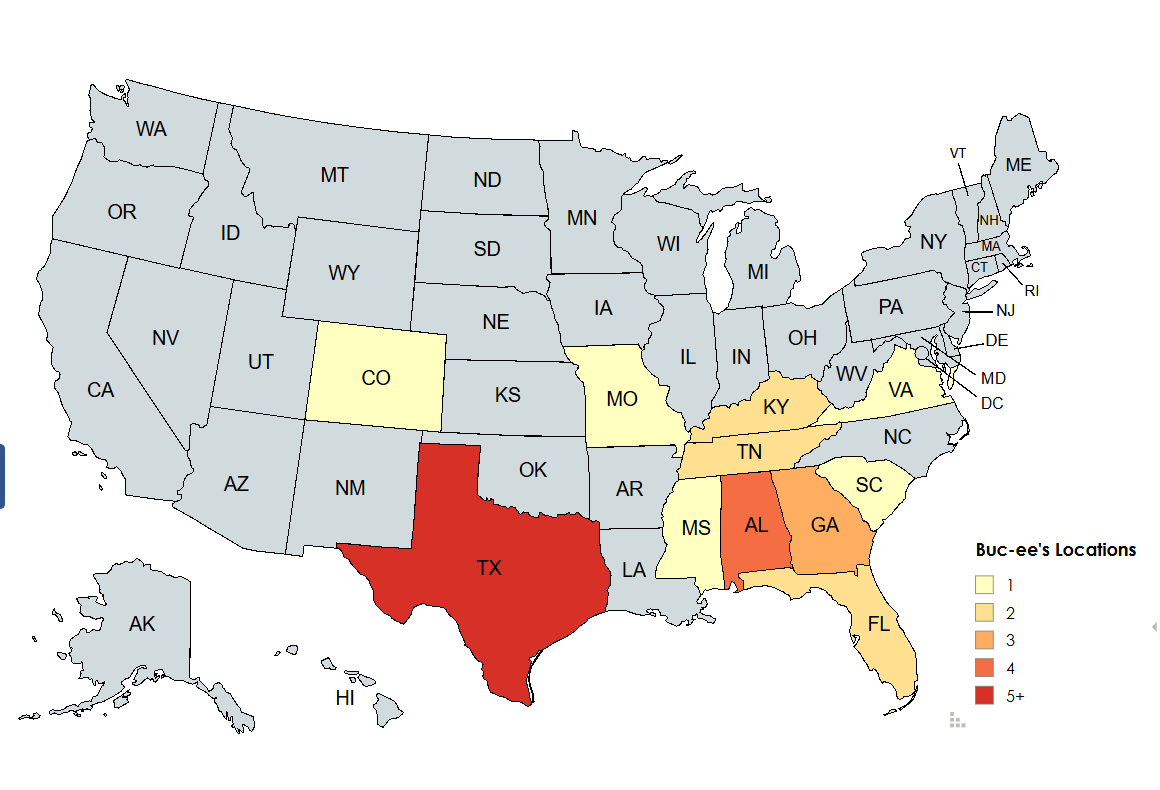
Location map 1
Note: Gray indicates no locations.
Location map 2
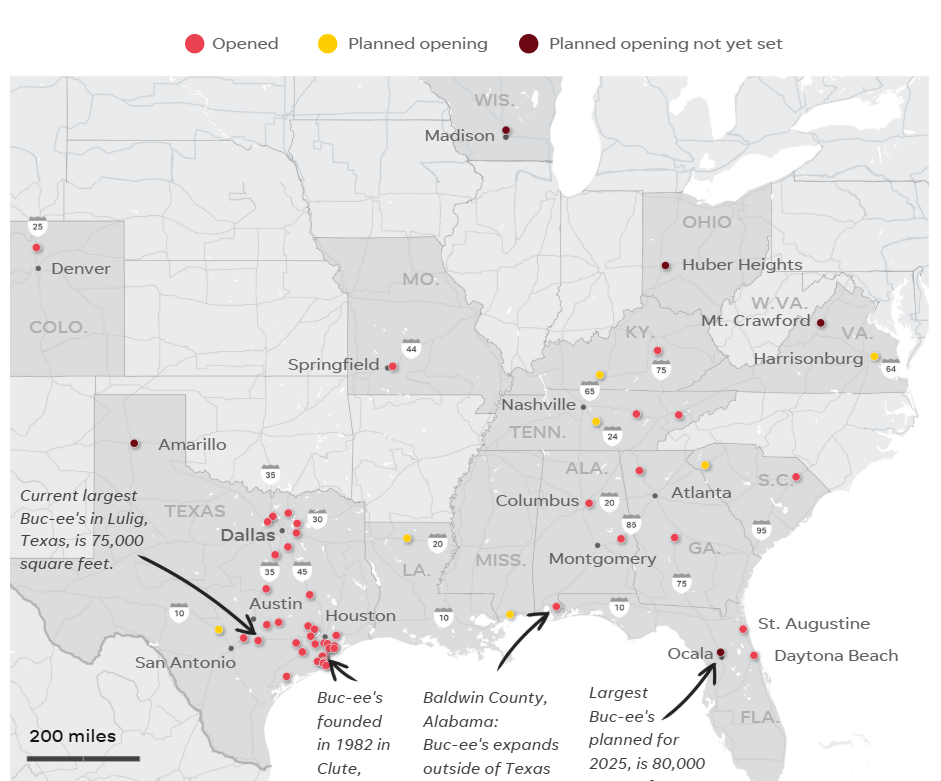
As seen in the maps and tables above, Buc-ee’s locations are permeating the South of the United States. Each Buc-ee’s is between two larger destinations, on some larger highway system. These are less populated areas. This location pattern highlights the market Buc-ee’s aims to capture: travelers. I’ll get more into detail on the specific customer base later.
Due to the nature of Buc-ee’s locations, there is lots of potential room for growth in the USA. Already spanning as far west as Colorado and east as Virginia, the reach of the chain has grown well beyond Texas in recent years.
Why Do People Choose Buc-ee’s?
Travel stop gas stations and convenience stores are ubiquitous in America. So what makes Buc-ee’s so special that a driver would choose to stop there, opposed to any other?
According to a survey by Payless Power, Buc-ee’s was named second best gas station stop in America. Costco was the sole competitor to beat out Buc-ee’s in favorability. “Between cleanliness, price, food quality and customer service, only two stations, Costco and Buc-ee's, made the top five in all four categories,” Payless Power wrote. “They also took first and second place, respectively, for the overall best-rated gas stations.” Costco beat out Buc-ee’s due to convenience and ease of access. Buc-ee’s had the longest travel time customers would travel to access. Due to the general remoteness of the locations, this ends up not being as convenient as Costco would be.
Further proof for large love for Buc-ee’s can be seen in the Buc-ee’s Lovers Facebook group. With over 275,000 members, the scale of this fanclub is nothing to sneeze at. It shows a clear, persistent adoration for the beaver.
Anecdotally, earlier this year, I wore a shirt I obtained at Buc-ee’s. It was a simple black Buc-ee’s shirt with the logo on it. The day I wore it, I received four separate compliments, an astonishingly unexpected reaction from my end. Often, people see others wear clothing they appreciate, but not often do people compliment it verbally. Yet another sign of the influence Buc-ee’s has.
But where does this stem from?
I believe there are a couple of factors to the attractiveness and luminosity of Buc-ee’s that are unique to it.
First off is the “door handle,” so to speak: the cheap gas. Gas prices at Buc-ee’s are generally lower than those of competing gas stations nearby. Almost automatically, this makes Buc-ee’s a preferable stop to refill.
Combine that with the fact 18-wheeler trucks are not allowed on the premises. Such a rule prevents clogged traffic and allows cars to move freely. The gas filling experience becomes a desirable commodity.
After the door handle is the foot-in-the-door. The foot-in-the-door for Buc-ee’s is the exceptionally well-maintained, massive bathrooms. According to USA Today, “After buying gasoline, 1 out of 5 people use restrooms, Lenard says. For travelers, that means ‘the bathroom is literally the front door.’”
But the bathroom offers more than just a service required by all humans. “You start there, at the restroom,” Lenard says. “Your perception of the store is tied to what the bathroom looks like. If it’s good, you’re going to shop. If it’s not, you’re going to leave.”
In fact, Buc-ee’s even won the Best Bathroom in America Award in 2012. Anyone entering a bathroom in a new establishment, of any kind, will immediately judge it upon first glance of the restroom. A clean bathroom has immense implications for reputation.
Next, once the foot’s in the door, the customer enters. The next major factor is the impeccable customer service offered by the lovely team members at Buc-ee’s. “Ninety percent of those who said Buc-ee's was their favorite gas station chain said it was because of its customer service,” according to Express News.
From my experience, I concur with this sentiment. The team members take enough care to welcome any and every person who enters the store. The warm, welcoming feeling makes entering the store not just a bathroom break, but an experience in and of itself.
The checkout experience is something of awe itself. The workers are expeditious with their operations. Any customer with a need for napkins or utensils for the fresh food they purchased can be obtained from the cashier, too. This is less convenient than self-service. However, it provides the act of kindness and caring directly from an individual. Nowadays, when human connection seems to be dwindling, Buc-ee’s continues to offer warmth and comfort appreciated on an otherwise arduous journey.
Finally, we have the most visually impressive aspect of Buc-ee’s: the size. Most travel centers are quite humble, and Buc-ee’s is no exception to this for many of its locations. Yet, it also has some of the most gargantuan convenience stores the world could ever hope to set its eyes on.
Just as highway-side attractions like giant balls of hay seize the attention of travelers, so too does Buc-ee’s. Having owned the largest stores of its kind for multiple years, only losing the record to itself, Buc-ee’s is unique in its behemoth activities.
But why does size matter? Buc-ee’s is at the heart of Texas culture. And of course, we all know everything’s bigger in Texas; so is Buc-ee’s.
Texas has lots of cultural capital within America, and recently growing in the world. Buc-ee’s is a core part of Texan culture, a shining star. Being a star of Texas, it has the potential for larger greatness, shining for America or even the world.
Now that we’ve covered much of what I and others think results in the success of the company, how is that actually reflected?
Buc-ee’s Revenue
Buc-ee’s is a privately owned company, so revenue and other financial information is not readily available. However, there are some publicly available statements that I’ve used to make estimates.
Something interesting to note is Buc-ee’s only moves into new regions to build a location if and only if they are able to receive a proper tax incentive. For the risk and expenditure the company has to take on, this is a reasonable ask, especially for the value they provide for a generally unpopulated area.
In one deal, Buc-ee’s was offered a 50% reduction in the 1.5% sales tax enacted by the city, lasting a period of 20 years. The deal is purportedly worth $4.5 million for the theoretical East Amarillo Buc-ee’s.
Calculations
Revenue * Tax_Rate * (1 - Discount) = Tax_Revenue
Revenue * 0.015 * (1 - 0.5) = 4.5 * 10^6
Revenue = 600 * 10^6
This revenue value is for the whole 20-year period.
By dividing by 20, we get the approximate expected yearly revenue, approximately $30 million. The Buc-ee’s in question was expected to be approximately 53,000 sq ft.
Additionally, the city of Denton paid $8.1 million in tax incentives to get a Buc-ee's along I-35 east, Texas Monthly reported. In February, elected officials in Springfield, Missouri, approved $8.5 million in city tax incentives in February to bring a Buc-ee’s there, according to the Springfield Daily Citizen.
This information allows us to estimate the size of other locations. Furthermore, by doing the same calculations as earlier, assuming the incentive structure was the same, we obtain $54 million and $57 million in yearly revenue for Denton and Springfield, respectively.
Here are size information for some locations, including the previous:
- Denton: 55,000 sq ft, 122 fuel pumps
- Springfield: 53,000 sq ft, 120 fuel pumps
- Luling, TX: 75,593 sq ft, 120 fueling positions
- Sevierville, TN: 74,707 sq ft
- Fort Pierce, FL: Expected to be >76,000 sq ft
The Buc-ee’s locations can be divided into three different size categories: Compact, Standard, and Mega. There are 18 compact, 25 standard, and 8 mega. There are a total of 51 stores, all within the continental United States.
I can now make two assumptions about the revenue per store. Either all stores make the lower $30 million annually or near the upper end of $57 million. This results in an annual revenue between $1.53 billion and $2.91 billion.
According to Michael Streit from Harvard Business School, he estimated a revenue of $12–20 million per new store in 2015. Accounting for inflation and assuming no changes in growth, this would be $16 million to $27 million in 2025. By applying this range with the previous method, we receive possible annual revenues of $816 million to $1.38 billion.
To best account for the differences in these estimates, I decided to use weighting. The compact sizes Buc-ee’s is expected to make the least, the standard the middle amount, and the mega the most. Without internal information, this is the best estimate I can make. Thereby:
(16 * 18 + 30 * 25 + 57 * 8) * $1 million = $1,474 million in annual revenue
However, according to another source, Local Pulse News: “Buc-ee’s estimated revenue in 2022 was $2.5 billion, with a net income of $200 million. The company’s revenue has been growing at a rate of about 20% per year in recent years.”
Why is there a discrepancy?
Some of the original calculations I made were reliant on sales tax, something not applied to the gas sold at Buc-ee’s, another source of income. Aforementioned CEO Aplin mentioned that unlike many convenience stores that receive just 1/3 of their revenue from in-store sales, Buc-ee’s receives 2/3 of their revenue from in store sales.
Assuming this statement is accurate and all previous calculations were made using the sales tax estimates, we multiply our previous result by 1.5. This provides us a value of $2.241 billion in total annual revenue, accounting for two major sources of income, not far off from the Local Pulse News estimate.
To be conservative, I’ll still estimate the annual revenue to be between $1.3 billion and $2.2 billion.
Valuation
Once again, due to the private nature of Buc-ee's, there's no information on the valuation of the company either. Since I've been able to make an estimate on the yearly revenue of Buc-ee's as a whole, I can also value the company based on extrapolations from said estimate.
In order to value the company, the method I aim to use is by comparison with similar entities. Buc-ee's is not so unique of an establishment to prevent comparisons with other companies. Therefore, I have selected the following public companies as viable comparisons: Casey's (CASY), Murphy USA (MUSA), Alimentation Couche-Tard (ANCTF), and, of course, 7-Eleven (SVNDY).
Imprtantly, all of these companies are much larger than Buc-ee's. Any calculation made will need to be taken with a grain of salt due to this. However, it is also an indicator of the theoretical market scope Buc-ee's could aim to expand into, even if their strategy is different.
CASY has a market cap of $24B, net income of $0.85B, and revenue of $16.4B. MUSA has a market cap of $9B, net income of $0.557B, and revenue of $19.5B. ANCTF has a market cap of $50B, net income of $3.25B, and revenue of $72B. SVNDY has a market cap of $35B, net income of $2.75B, and revenue of $80B.
Calculations
First I will calculate the ratios of profit margin for each company stated. CASY is 5.18%, MUSA is 2.86%, ANCTF is 4.51%, and SVNDY is 3.4%. From here I'll be taking an average. Normally, I would intend to weight in accordance to which stores seem most similar, especially in size. However, since all of these stores seem so vastly different to Buc-ee's, I see no point in pursuing that. Buc-ee's seems to produce over 3x more revenue per store than many of these other companies. Due to that, I would assume less fixed costs. However, this is an assumption I cannot verify so I will assume it is the same as the others for sake of simplicity.
I calculated the profit margin for eacch company based off the figures provided earlier: CASY at 5.2%, MUSA at 2.9%, ANCTF at 4.5% and SVNDY at 3.4%. I then averaged these values and multiplied it with my previous revenue estimate to obtain an estimate net profit from $52 million to $87.9 million. Averaging those, we end up with an estimated $70 million in profit annually.
I obtained an average of the Market Cap / Net Income ratio, and used that value to estimate a possible market cap. Using this method, Buc-ee's would be valued at $1.27B. However, it is important to note that market cap uses present valuation of the sample companies while the revenue and profit information is from the past. Using the P/E ratio of these companies instead, and averaging to use in place of the Market Cap / Net Income Ratio, I obtained a market cap of $1.8B.
These are clearly two very different numbers. Furthermore, they are already extrapolated off averages, so the real variation is much more pronounced than this. I would take the less conservative valuation and use the $1.8B valuation for Buc-ee's.
Many of my numbers for Buc-ee's were from older figures, especially the tax exemptions. I would assume the company has grown more since then, especially with the expansion of stores across the country within the past decade. The average P/E ratio using those values would be at 25.75, high but not unreasonably so. Along with any growth they likely had, the ratio only grows smaller.
What makes Buc-ee’s Particularly Powerful?
Power is an idea outlined by Hamilton Helmer in his book Seven Powers. He defines it as “a set of conditions creating the potential for persistent differential returns.”
These Powers include the following:
- Network Effects
- Switching Costs
- Cornered Resource
- Process Power
- Scale Economies
- Counter Positioning
- Branding
Powers Buc-ee’s does not utilize (in this analysis)
Network effects: Buc-ee’s does not explicitly benefit from network effects. Network effects are defined by the value of the product increasing for each user who uses it. If the number of customers at Buc-ee’s increases, there is no real benefit to any other customer.
Switching costs: Buc-ee’s customers have no real switching costs. A switching cost is defined by a customer paying a “cost” to move to a competitor. Generally, this involves a need to reorganize, learn, or transfer information in order to use an alternative. A customer at Buc-ee’s does not pay any opportunity cost for going to any other travel stop.
Cornered resources: At a fundamental level, there does not seem to be any significant cornered resource at Buc-ee’s. A cornered resource is some material, good, etc. that a company has access to that competitors cannot obtain or use, providing a competitive advantage. Although Buc-ee’s has products unique to the store, they are not items that other businesses could not copy or have an alternative for.
Powers that are unknown due to private operations
Process power: This requires inside knowledge of the company organization, so it is unable to be determined.
Scale economies: It’s hard to determine the significance of scaling on Buc-ee’s operations without internal knowledge. Buc-ee’s ranks at 136 in the U.S. based on store count. There is likely to be some benefit from the amount, but likely not immense.
Powers that provide Buc-ee’s an edge
Counter-positioning: Buc-ee’s offers three unique primary points of value to a customer: cheap gas, clean restrooms, and the size of the stores. Restroom cleanness is something any competitor could accomplish; cheap gas is harder to copy and provides a strong position. The size and scope of the stores is extremely powerful counter-positioning—it requires heavy investment and makes it unlikely for competitors to compete in that realm.
Branding: Perhaps the greatest power Buc-ee’s has is its branding. Branding means a customer is likely to choose one of two otherwise identical products simply due to the brand label attached to it.
Buc-ee’s has developed strong brand trust due to the previously mentioned values in counter-positioning. Anytime the brand itself is seen, these values are seen along with it.
Buc-ee’s has the unique characteristic of being Texas-branded as well. Texas has one of the strongest branding and cultures among the American states. This feature gives Buc-ee’s a lot of additional power, especially regionally. We see this reflected in the geographical choices of new Buc-ee’s locations.
Few, if any, other convenience and fuel stations have the brand recognition of Buc-ee’s. Having such a strong power to back it up gives us insight into the potential and stability Buc-ee’s has. I believe the company can continue to make major strides in expansion and cultural influence; all it needs is time.
-- Nikhil
Sources
- Price, S. (2023, February 7). Buc-ee's is the second-best gas station in the U.S., survey says. So, who is No. 1? San Antonio Express-News.
- Payless Power. (n.d.). Americans choose Costco as their favorite gas station.
- USA Today. (2023, November 22). Why are Buc-ee’s gas stations so popular?
- Amarillo Globe-News. (2022, February 9). City council economic incentives: Buc-ee’s travel center east Amarillo.
- Fanning, T. (2022, June 3). Taxpayers will likely pay millions in incentives to fuel Buc-ee’s expansion plans in Luling. San Antonio Express-News.
- Pokin, S. (2022, February 14). Is Buc-ee’s good for Springfield? Your questions explored. Springfield Daily Citizen.
- Segrest, M. (2024, August 13). The world’s biggest Buc-ee’s lands in Luling. Bluebonnet Electric Cooperative.
- ArcGIS Online. (n.d.). Map Viewer [Web map].
- North Texas Daily. (n.d.). New Buc-ee’s opens in Denton along Interstate 35.
- Streit, M. (2015, December 9). Porcelain God: The Buc-ee’s empire. Harvard Business School Digital Initiative (HBS D³).
- Gentile, E. (2024, March 20). How to Buc-ee’s: Part 1. Local Pulse News.
- CSP Daily News. (2025). Top 202 convenience stores 2025.